Specifying custom tatami storage bedroom furniture china factory for Wholesale and OEM Orders
Before comparing quotations, align the mattress footprint, storage access, board specification and pack-out. A lower ex-factory price can become a higher cost per unit sold if panels arrive chipped, lift hardware needs adjustment, or the assembled bed does not match the approved dimensions.
For wholesale and OEM orders, the useful comparison is the expected return and complaint rate across repeat batches—not the unit price in isolation. Specify the construction that fits your retail price point, freight plan and destination requirements before the factory prepares its quotation.
Materials and Construction Trade-offs
Swelling at exposed edges, stripped connector holes and sag across a wide storage base are common sources of avoidable returns. Match the board and support layout to the bed span, access method and expected assembly frequency; no panel grade compensates for an undersized support structure.
| Specification area | Common choices | What changes for the buyer |
|---|---|---|
| Main panels | Particleboard, MDF or plywood; commonly 15–18 mm where the design permits | Particleboard can reduce material cost; plywood often offers better fastener retention. Final choice depends on panel span, support spacing and finish. |
| Backs and drawer bottoms | Thin fibreboard or plywood, often 3–9 mm by function | Thicker panels add cost and pack weight; thin panels need sound grooves, fixing points and support to limit flex. |
| Exposed edges | PVC or ABS edge band, commonly 0.8–2 mm depending on location | Thicker banding can better mask impact marks on visible edges; colour, gloss and edge radius need approval against the face finish. |
| Storage access | Lift-up frame with matched hardware, or fixed drawers on runners | Lift-up access uses more hardware and needs clearance; drawers simplify top access but require runner alignment and side clearance. |
If the product includes a woven tatami mat rather than a finished panel platform, specify the mat material, thickness, colour and attachment method separately. Do not treat the mat as a structural bed component unless the design has been reviewed for that purpose.
How It Is Built and What That Changes
Process rule: lock the approved panel thickness, edge treatment and drilling positions before production cutting. A change to any one of these can shift connector fit, drawer alignment or the finished mattress opening.
Two suppliers quoting the same specification may use different panel nesting, edge-banding setups and assembly controls. A typical made-to-order sequence is panel cutting on CNC equipment, edge application, hole drilling, hardware preparation and trial assembly. Fixed panel dimensions and a controlled drilling program help keep repeat orders within the approved fit.
Lift-up units need a matched frame, hinges or lift hardware, and support points selected for the mattress and storage layout. Drawer versions need square carcasses and parallel runners. If hardware holes move between batches, assembly time rises and the bed may rack under use; keep the drilling file and hardware specification tied to the approved revision.
A pre-production sample should confirm the mattress opening, access motion, visible edge match and packed component count. Cutting and drilling programs are usually more repeatable once the dimensions stop changing, so late revisions can add setup time and delay the confirmed production slot.
Where This Product Beats Standard Alternatives
Custom Tatami Storage Bed
A custom footprint can coordinate the mattress recess, storage volume, room layout and retail carton plan. That fit can reduce mismatch complaints when the buyer serves a defined mattress range.
Standard Platform Bed
A fixed size can simplify replenishment and support larger production runs. It may leave a gap in the assortment when the market needs a different mattress footprint or storage access arrangement.
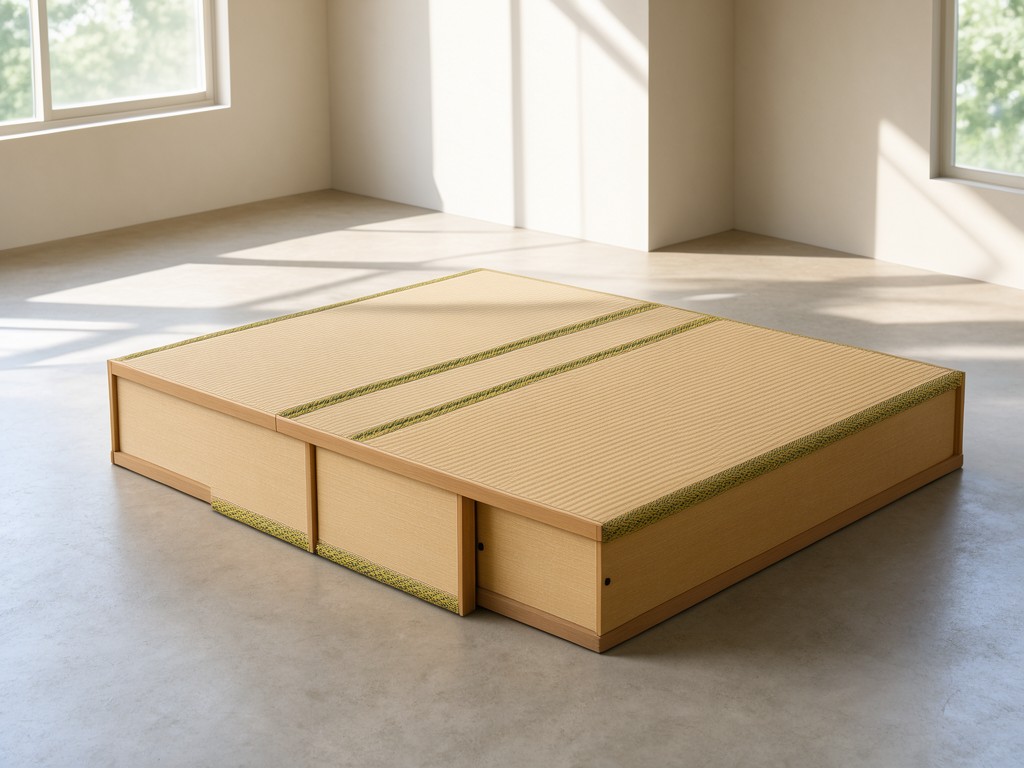
Unit price and service life diverge when the structure is priced for purchase cost alone. Wider unsupported panels, low-spec runners or poorly protected edges may reduce the initial quote while raising assembly issues, damage claims and replacement-part requests. Custom construction is most useful when its dimensional fit or storage layout gives the buyer a clear reason to stock it.
How to Choose Before Requesting a Quote
- Set the mattress dimensions and finished bed footprint first. State whether the mattress sits inside a recess or on a flat platform, and identify the clearance required around it.
- Choose lift-up access or drawers. For lift-up designs, provide the intended opening direction and mattress assumptions; for drawers, confirm opening direction, runner type and required side clearance.
- Define the board grade and thickness by component, not just as “wood board.” Include visible face finish, edge-band material and thickness, and any destination-market emissions or labelling requirements that apply.
- Request a packed-volume estimate and confirm whether the order ships flat-packed. Carton dimensions, protection and hardware bagging affect freight cost and the chance of damage in transit.
- Compare quotes against the same drawings, hardware list, finish sample and test expectations. A price comparison without these details can conceal a different structure or pack-out.
For load expectations, provide the intended use and support layout for factory review. A stated load limit without panel span, central support and hardware details is not a useful basis for comparison.
What Can Be Customised and What Cannot
Can Be Specified
Overall dimensions, storage configuration, board combinations, surface colour, edge banding, handle style, hardware selection, logo placement, carton artwork and assembly instructions can be agreed for the order.
Needs Engineering Review
Changes to span, panel thickness, support spacing, lift hardware or mattress clearance can affect stiffness, assembly and access. The factory should review these together rather than price each change as a finish option.
Requires Approval
Colour, surface texture, edge match and printed packaging need a signed-off sample or artwork file. Digital colour references alone may not predict the final appearance across different board finishes.
A custom size does not automatically retain the cost or pack efficiency of a stock design. New panel dimensions may change nesting yield, while extra hardware or a changed drawer layout can alter carton count and assembly steps. Confirm the revised sample and packing plan before releasing a repeat order.
Quality Control and Batch Consistency
Check Fit, Finish and Function Against the Approved Sample
Finished dimensions, mattress opening and panel thickness should be checked against the signed drawing. Small dimensional drift can make the bed difficult to assemble or leave uneven reveals; a batch should use one controlled drawing revision and identified finish reference.
Inspect face panels for chips, scratches, colour variation and edge-band gaps. Check connector holes and hardware fit on sampled units, then assemble a sample to assess squareness, drawer travel or lift movement. Edge bond and finish checks should focus on exposed corners and high-contact areas, where early wear is most visible.
Agree any load or repeated-operation test before production, with the test setup and acceptance criteria tied to the actual design. A lift cycle check, for example, should use the specified frame and hardware; a result from a different mattress or support layout does not validate the buyer’s configuration.
Packing, Marking and Freight Configuration
Flat-pack protection: separate finished faces with suitable interleaving, protect panel corners and secure loose hardware in labelled bags. Packaging should prevent panels from rubbing during handling, not only cover them from dust.
Carton identification: use the buyer’s item code, finish, carton sequence and assembly reference where required. Clear component and hardware identification reduces warehouse sorting errors and missing-part claims.
Freight review: confirm carton dimensions, gross weight, stack limits and container plan from the final pack sample. A revised panel size or added protective layer can change the shipment volume and landed cost.
Retail labels, assembly sheets and carton marks should be approved before mass packing. If the importer needs specific language, barcodes or handling marks, provide print-ready files and a final proof; changes after carton production can create relabelling work or delay dispatch.
Request a Tooling and Process Review
Send the mattress dimensions, storage layout, panel schedule, finish references and destination packing requirements for a review of CNC panel programs, drilling positions, assembly fixtures and carton configuration. This check can identify cost or fit issues before the sample and quotation are locked.
Submit drawings for a tooling-review discussion