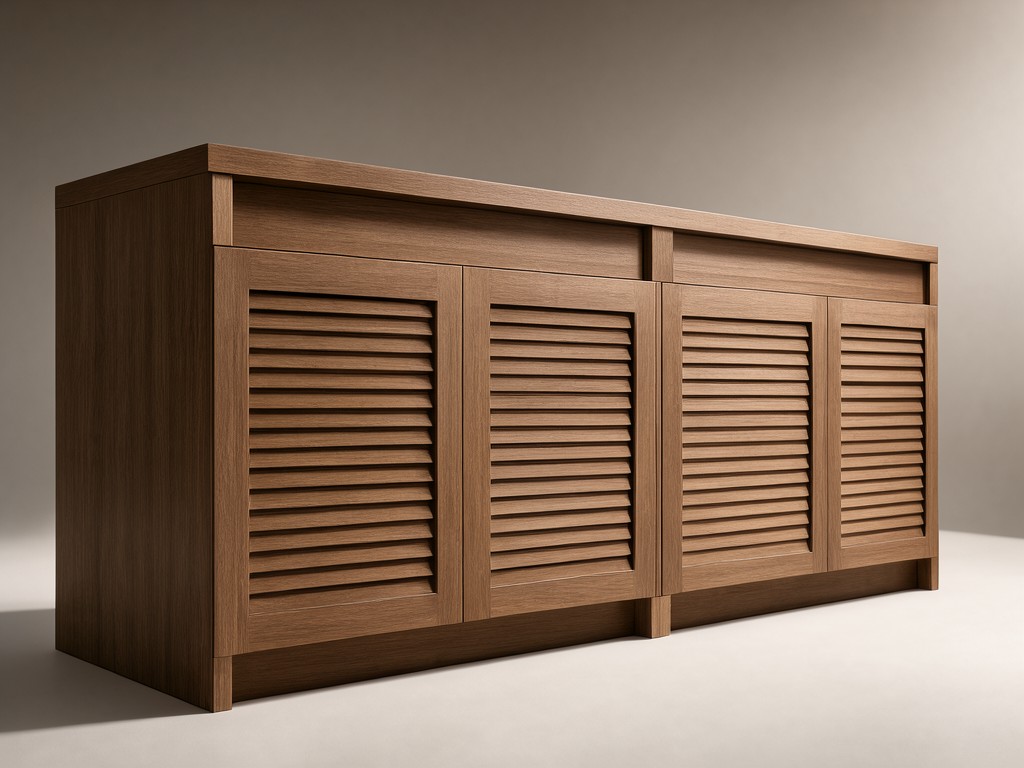
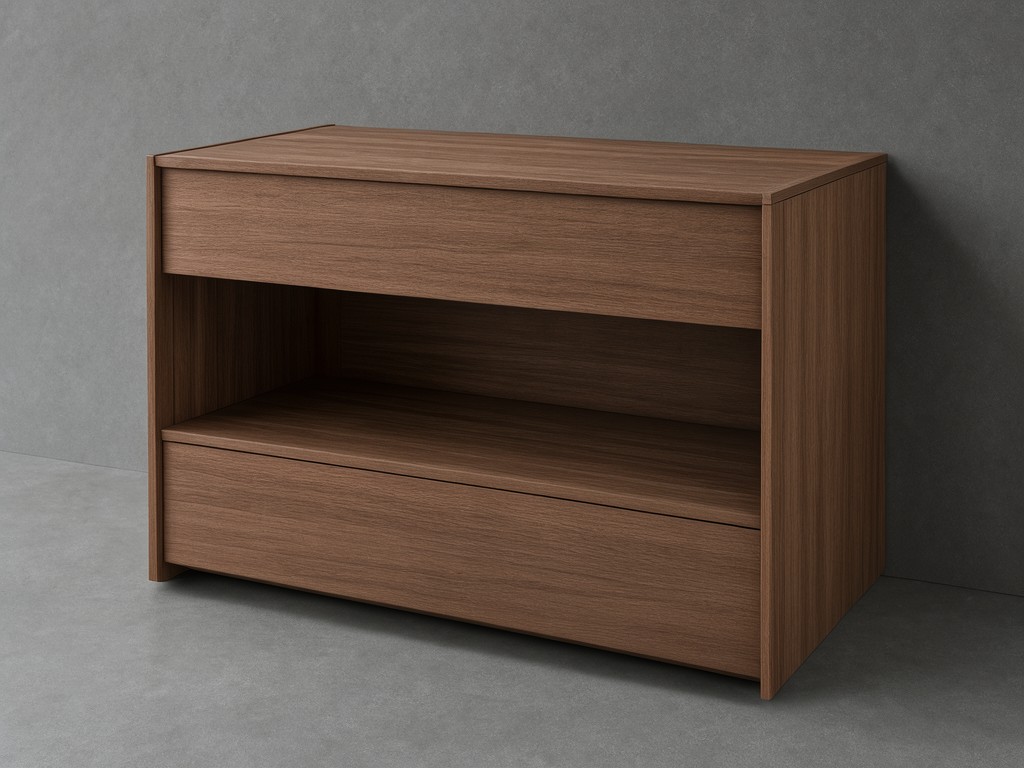
Specifying wholesale walnut wood bathroom vanity suppliers for Wholesale and OEM Orders
Cabinet swelling usually starts at an exposed edge or plumbing cutout, not across the walnut face. A stable panel core with walnut veneer costs less than an all-solid-walnut case and moves less with bathroom humidity; solid walnut belongs where visible timber thickness is part of the specification. Agree the construction, finish, and water-exposure limits on an approved sample before comparing supplier prices.
Returns for swollen doors, chipped corners, or mismatched replacement fronts can erase a unit-price saving during a retail season. For a second source, compare like-for-like drawings, hardware, finish schedule, and packing scope, then use the same approval standard with both factories.
What the Design Has to Balance
Design Perspective
A vanity cabinet has to hold its door and drawer alignment while taking repeated splash exposure, cleaning, and the load of its specified countertop and basin. Wider spans and deep drawers increase leverage on the cabinet joints and runners; reinforcing the case or selecting hardware for the actual drawer load adds cost but can reduce service calls. The decision rule is to set the maximum countertop load, drawer use, and installation conditions before the factory freezes panel thickness and hardware.
A second-source drawing should identify overall width, height, and depth; finished side and front dimensions; basin and trap clearances; wall fixing points; and the countertop interface. Mark which dimensions are critical for installation and which allow normal production variation. If those points are left to interpretation, nominally identical cabinets can arrive with incompatible plumbing access or reveal lines.
| Planning size | Typical cabinet envelope | Indicative cabinet weight | Drawing check |
|---|---|---|---|
| Compact, 600–750 mm wide | About 450–520 mm deep and 800–900 mm high | Roughly 25–50 kg | Confirm basin position, trap space, and wall fixing access. |
| Standard, 800–1000 mm wide | About 450–550 mm deep and 800–900 mm high | Roughly 35–70 kg | Check drawer clearances against the waste and supply lines. |
| Double-basin, 1200–1500 mm wide | About 450–550 mm deep and 800–900 mm high | Roughly 55–100 kg | Confirm support, wall anchoring, and two-basin plumbing routes. |
These are planning envelopes for cabinet-only units, not manufacturing tolerances or a promise of final shipment weight. Solid-timber content, drawer count, hardware, and packaging change the weight; the approved shop drawing and packed sample configuration should govern the order.
How It Performs in Use
Working Principle
The finish slows moisture uptake at intact surfaces; it does not make the cabinet waterproof. Water that sits at an unfinished underside, screw hole, or sink cutout can reach the core, swell an edge, and disturb door gaps. Specify sealed edges and cutouts, and keep the care instructions clear about standing water and prompt wipe-downs.
In a family bathroom, frequent drawer cycling and wet-hand contact make runner adjustment, replaceable handles, and access to fixings useful service features. In a guest-bathroom fit-out with lighter daily use, the buyer may instead prioritize a thinner visual profile or more figured walnut veneer. Compare these use cases on a physical sample: veneer tone, edge treatment, door feel, and finish sheen are difficult to judge from a rendering alone.
Materials and Construction Trade-offs
Material Selection
Walnut veneer over a moisture-resistant engineered panel gives buyers a consistent cabinet geometry at a lower timber cost than solid walnut throughout. Solid walnut costs more and shows genuine timber edges, but seasonal movement requires careful panel design and finish coverage on all faces. Ask the supplier to state the core, veneer face, exposed-edge treatment, and finish system by component rather than using “walnut wood” as a complete material description.
| Construction option | Cost and appearance | Points to approve |
|---|---|---|
| Walnut veneer on plywood core | Moderate cost; stable panel format with natural veneer variation. | Veneer matching, edge banding, sealed cutouts, and the plywood grade stated on the drawing. |
| Walnut veneer on moisture-resistant MDF | Often a cost-conscious route to a smooth, even veneer face. | Confirm edge sealing and avoid treating the panel as suitable for prolonged wetting. |
| Solid walnut visible components or case | Higher material and machining cost; visible timber edges and grain. | Allow for grain and color variation, timber movement, and balanced finishing across faces. |
If the retail promise depends on a close grain match across doors and drawer fronts, the supplier needs a defined veneer-selection method and an agreed sample range. Exact matching raises sorting time and may increase material yield loss; accept controlled natural variation where the price point does not support book-matched faces.
How It Is Built and What That Changes
Manufacturing Process
Production typically starts with panel and timber preparation, veneer pressing, CNC cutting, edge treatment, and dry assembly. The factory then sands the visible surfaces, applies the agreed stain and clear finish, installs hardware, and checks the assembled cabinet against the approved drawing. Process details matter: a rushed finish schedule or an unsealed routed edge can show up as color variation, peeling, or swelling after installation.
For a second source, compare a signed-off preproduction sample against a dated drawing revision. Mark the acceptable color range, sheen, veneer direction, edge radius, handle location, and drawer gap on the approval record. Any change to panel supplier, finish formula, hardware model, or cutout position after approval should trigger written buyer review rather than an informal production substitution.
Assumptions Buyers Should Stop Making
Common Mistakes
“Walnut” does not tell you whether the doors are solid timber, veneer, or a printed surface, and “water-resistant” does not define how long a finish withstands standing water. A product photo also cannot confirm that a trap clears the top drawer or that a wall-hung model includes appropriate fixing provisions.
Do not transfer a supplier’s standard tolerance to every dimension without checking the installation interface. Agree specific tolerances for overall size, squareness, drawer gaps, and mounting-hole position on the drawing; keep cosmetic variation rules separate from fit-critical limits. Cost savings from skipping that agreement can reappear as site modification, replacement fronts, or a disputed claim.
What Can Be Customised and What Cannot
Customization Options
Door and drawer layout, cabinet width, basin clearance, handle style, finish color, veneer selection, and brand marks can usually be specified. Changes to widths or cutouts may require revised CNC programs and a new sample; tooling amortisation decides whether a one-off profile change makes sense at the planned order quantity. Request a quote that separates setup or tooling charges from the unit price.
Natural walnut grain and tone cannot be made identical from batch to batch. Artwork for a logo, carton, or care insert can be controlled, but the buyer must supply approved vector files, print colors, placement dimensions, and final copy before production. Once the sample and artwork proof are signed, changes to finish color, hardware, or dimensions need a revised approval and may change both cost and schedule.
Inspection Items and Test Methods
Inspection and Testing
A practical inspection plan checks dimensions against the approved drawing, verifies diagonals and door gaps, and confirms that drawers travel without binding. Inspect veneer for open joints, lifting, sanding-through, and unacceptable color differences; examine finish coverage at undersides, cutouts, and exposed edges. Operate doors and drawers repeatedly during inspection and record any loosened hardware or alignment drift.
A controlled wipe test can check the agreed cleaning exposure on a sample, while a finish adhesion check should follow a method and acceptance rule agreed by buyer and factory before the order. Neither test replaces correct installation or proves resistance to standing water. Retain a signed reference sample and inspection record by production lot so a reorder or warranty review has a clear baseline.
Packing, Marking and Freight Configuration
Packaging and Logistics
Cabinet corners, finished faces, and projecting handles need protection against carton movement and impact during export handling. Confirm whether units ship assembled, with handles detached, or in a knock-down configuration; each choice changes packing volume, assembly labor, and the chance of transit damage. The packing sample should match the finished product and include the actual protective materials before carton approval.
Agree carton markings, SKU and color identification, gross and net weight fields, country-of-origin details, barcode placement, and any retailer-specific labels before printing. Add batch identification that links the carton to the production lot and approved finish sample. For mixed-size shipments, review pallet layout and carton counts against the freight plan so cabinet weight and stack height do not compromise the lower cartons.
Request a Sample for Second-Source Approval
Use a sample request to qualify construction, finish, fit, and export packing before placing a wholesale or OEM order. Send the target drawing, material schedule, finish reference, hardware requirements, artwork files, and required carton marks; ask the supplier to return a dimensioned sample record and a list of proposed deviations for written approval.