wholesale wall mounted bathroom vanity cabinet suppliers: Specification, Ordering and Quality Notes
During a private-label launch with a fixed ship date, the margin between a successful retail debut and a costly return wave often comes down to two variables: the moisture resistance of the carcass and the consistency of the door panel flatness. Wholesale buyers of wall-mounted bathroom vanity cabinets frequently report that the initial sample looked correct, but the mass production run arrived with swollen MDF edges or misaligned hinges after three weeks in humid store environments. This is rarely a manufacturing defect; it is a specification mismatch between the buyer's environmental assumptions and the material grade selected by the supplier.
The Problem Buyers Keep Paying For
When a brand extends an existing range, procurement teams often look for cost reductions by switching from solid wood to engineered wood or from lacquered surfaces to melamine. While the unit price drops, the failure rate in humid climates rises. The most common complaint in post-sale support is "panel bowing" or "edge delamination." This happens because standard MDF or particleboard lacks a sufficient moisture barrier. Water wicks up through the end-grain of the board, causing the internal fibers to expand. Once the core expands, the veneer or laminate surface cannot accommodate the stress, leading to bubbling or cracking.
Critical Failure Point: The Edge Seal
The perimeter of the cabinet is the primary entry point for moisture. If the edge banding is applied at less than 120°C, the adhesive bond weakens. For bathroom applications, specify high-pressure edge banding or a PVC strip with a heat-activated EVA adhesive to ensure the seal withstands repeated steam exposure.
| Environmental Condition | Typical Failure Mode | Preventative Specification |
|---|---|---|
| High Humidity (>70% RH) & Steam | MDF core swelling, laminate bubbling | Marine-grade plywood or MDF with melamine impregnated in the core |
| Direct Water Contact (Spills) | Water staining, adhesive failure on hardware | Stainless steel 304 hinges and soft-close dampers; sealed bottom panel |
| Thermal Fluctuation (Radiators/HVAC) | Door misalignment, gap variation between panels | Solid wood or stable engineered wood; allowance for 2-3mm expansion gap |
| Heavy Daily Use (Commercial) | Hinge fatigue, drawer slide wear, surface scratching | Blum or Hettich hardware; high-gloss acrylic or solid surface countertop |
Material Options and Their Trade-offs
Selecting the right core material is the single biggest determinant of both price and longevity. Most wholesale suppliers offer three tiers: Standard Particleboard, Moisture-Resistant MDF, and Marine-Grade Plywood. Standard Particleboard is the cheapest option, ideal for dry powder rooms or guest bathrooms where humidity is controlled. However, it fails rapidly in primary en-suites. Moisture-Resistant MDF offers a middle ground; the green wax treatment in the binder prevents immediate rot, but it is still susceptible to edge swelling if the banding is compromised.
Marine-Grade Plywood is the premium choice for high-end retail lines. It is cross-laminated with phenolic glue, making it nearly impervious to water. The trade-off is cost and weight. Plywood cabinets are 15-20% heavier than particleboard equivalents, which increases freight costs per container. For a private-label buyer targeting the mid-market, a hybrid approach is often used: plywood for the sides and top/bottom panels (the structural and high-risk areas), and MDF for the internal shelves and back panel (low-risk areas). This reduces material cost by approximately 12% while maintaining structural integrity.
Size, Weight and Specification Range
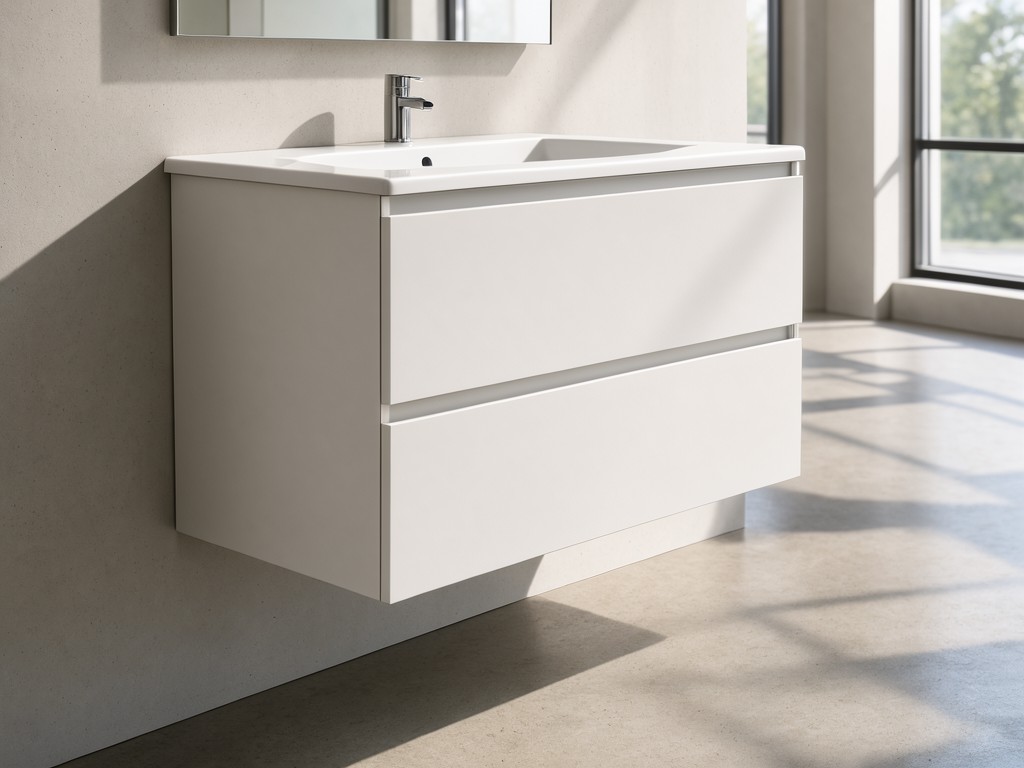
Standard wall-mounted vanity dimensions in the international market cluster around 600mm, 800mm, and 1200mm widths. Depth is typically 450mm to 500mm. Height varies from 500mm to 700mm depending on the inclusion of a drawer or open shelf. Weight consistency is critical for wall mounting; a 800mm unit in particleboard weighs roughly 18-22 kg, while the same unit in solid oak can exceed 40 kg. This difference dictates the type of wall anchors required. If the buyer is marketing to a DIY consumer, the installation hardware must be simple. If targeting professional installers, the weight can be higher, but the packaging must clearly indicate the anchor load rating.
| Dimension (W x D x H) | Material Option | Approx. Weight (kg) | Best Application |
|---|---|---|---|
| 600 x 450 x 500 mm | Particleboard | 12 - 14 | Guest bath, powder room |
| 800 x 450 x 550 mm | Moisture-Resist MDF | 18 - 22 | Primary en-suite, mid-range retail |
| 1200 x 500 x 600 mm | Marine Plywood | 32 - 38 | Double-sink luxury, coastal homes |
| 900 x 480 x 550 mm | Solid Oak | 45 - 50 | High-end custom, heritage styles |
What Can Be Customised and What Cannot
Moving from sample orders to container loads changes the economics of customization. In small batches, customizing the internal layout (e.g., adding a soft-close drawer instead of a shelf) is feasible and adds minimal cost. In large production runs, however, tooling amortization becomes the primary driver. Changing the width of the cabinet requires new CNC cutting programs and potentially new jigs for the edge banding line. If the buyer switches from a 600mm to a 700mm width, the entire panel cutting schedule must be re-optimized. Suppliers typically charge a setup fee for non-standard dimensions unless the order volume exceeds 500 units, at which point the tooling cost is absorbed into the unit price.
Customization of surface finish is easier than structural changes. Melamine paper comes in thousands of standard colors, so switching from White to Oak Effect usually has no cost impact. However, custom RAL colors for lacquered or painted finishes require a minimum of 1,000 units to justify the paint line changeover. For hardware, standard European cup hinges and soft-close slides are pre-installed. Replacing these with branded hardware (like Blum) adds cost but is a simple assembly line change. The buyer should specify the exact hardware model number to avoid substitution errors.
Low MOQ Customization
Applies to orders under 200 units.
- Standard dimensions only (600/800/1200mm).
- Standard melamine colors.
- Basic hardware (non-branded).
- Lead time: 30-45 days.
Full ODM Customization
Applies to orders over 1,000 units.
- Custom dimensions (50mm increments).
- Custom paint/lacquer colors.
- Premium hardware (Blum/Hettich).
- Lead time: 60-90 days.
Usage Scenarios and Buyer Segments
Different buyer segments prioritize different aspects of the vanity cabinet. A private-label buyer for a large home improvement retailer needs durability and consistent quality to minimize warranty claims. They will specify moisture-resistant MDF and standard hardware. A boutique furniture brand targeting luxury hotels will prioritize aesthetics and finish quality. They may choose solid wood or high-gloss acrylic, accepting a higher unit price for the visual impact. The usage scenario dictates the specification. A cabinet installed in a hotel bathroom must withstand daily cleaning with chemical agents and high-frequency use. The surface finish must be resistant to abrasion and chemical staining. In this case, a solid surface countertop and a sealed lacquer finish on the cabinetry are essential, whereas a matte melamine finish would fail within months.
For the DIY market, the "feel" of the product matters. Consumers often judge quality by the weight of the door and the smoothness of the drawer action. A well-balanced door with a soft-close mechanism creates a perception of premium quality, even if the core material is standard MDF. This is why many wholesale suppliers include soft-close dampers as standard in their mid-range lines. The cost increase is negligible (less than $1.00 per unit) but significantly improves the customer experience and reduces negative reviews related to "noisy" or "slammy" hardware.
Segment-Specific Requirements
Procurement officers for commercial fit-out companies require specific load ratings for wall mounting. They need to know the exact weight of the unit with the countertop installed to select the correct anchors. Suppliers should provide a weight certificate with each batch. For private-label buyers, brand protection is a key requirement. This includes custom packaging with the buyer's logo and instructions. The packaging must be stackable for palletization. A standard export carton for a 800mm vanity is approximately 850x550x250 mm. If the buyer requires custom-sized cartons, the minimum order quantity increases because the packing material must be pre-cut and stored.
Retailers selling in North America or Europe often require compliance with formaldehyde emission standards (CARB P2 or E1). The supplier must provide a declaration of conformity for the wood-based panels. This is not a suggestion but a legal requirement for import. Failure to provide this documentation can result in the container being held at customs. Buyers should request a sample certificate of analysis before placing the first order. Additionally, retailers increasingly demand recyclability information. Using mono-material construction (e.g., all MDF, no mixed plastics) simplifies the recycling process and aligns with sustainability goals.
OEM and ODM Programme Structure
The OEM (Original Equipment Manufacturer) program is suitable for buyers who have their own design and engineering. They provide the CAD drawings, material specifications, and hardware lists. The supplier executes the manufacturing. This model offers the highest level of control but requires a higher level of technical expertise from the buyer. The ODM (Original Design Manufacturer) program is for buyers who want to leverage the supplier's design library. The supplier offers a range of standard designs that can be modified in terms of size, finish, and hardware. This reduces the development time and risk, as the designs have already been tested for manufacturing efficiency and market appeal.
For both programs, the sample approval process is critical. A pre-production sample is manufactured using the exact materials and processes of the mass production run. This sample is sent to the buyer for inspection. The buyer checks the dimensions, finish, hardware function, and packaging. Only after written approval can the mass production order begin. This step prevents costly rework. If the buyer discovers a defect after the container has been loaded, the cost of return and repair is significantly higher than the cost of adjusting the sample. The supplier should clearly state the timeline for sample production and the conditions for approval.
Questions Buyers Ask Before Ordering
- What is the minimum order quantity (MOQ) for custom colors?
Standard melamine colors have a low MOQ (100 units). Custom paint colors require a minimum of 1,000 units to justify the paint line changeover and pigment matching. - Can we mix different sizes in one container?
Yes, most suppliers allow a mix of sizes and finishes in a single 40ft container, provided the total volume fits within the cubic meter limit (approximately 67 CBM). This allows buyers to test different configurations without committing to a single SKU. - How do you handle damage during transit?
All units are packed with corner protectors and air cushions. The supplier provides a damage report within 48 hours of arrival if any issues are identified. The insurance policy should cover "all risks" to protect against transit damage. - Is there a difference in lead time for sample vs. production?
Sample lead time is typically 7-10 days. Production lead time is 30-60 days depending on the complexity of the design and the material availability. Custom paint jobs add 10-15 days to the production timeline. - Can you provide installation instructions for our market?
Yes, the supplier can provide generic English instructions. For specific language requirements, the buyer should provide the translated text. The supplier will print it on the packaging if the order volume exceeds 500 units.
Request a Sample Kit
To evaluate material quality and construction consistency, request a physical sample of your preferred configuration. This includes a door panel, a drawer unit, and a set of hardware. This allows your quality team to verify the edge banding, finish durability, and hinge alignment before committing to a full container order.
Contact Our Sales Team for Sample Request