Specifying wholesale bathroom furniture vanity cabinet suppliers for Wholesale and OEM Orders
The build method decides whether a vanity cabinet holds its dimensions through production and bathroom use. For private-label and retail buyers qualifying a second source, start with the panel substrate, edge treatment, finish system and assembly method; those choices affect unit cost, moisture exposure tolerance and the likelihood of returns more than a small change in hardware price.
How to Choose Before Requesting a Quote
For apartment projects, retail replenishment and multi-unit renovations, define the cabinet dimensions around the basin, plumbing clearance and installation method first. A quote based only on overall width can conceal differences in usable drawer space, back-panel cut-outs or door swing that later become fit complaints.
Send the supplier a drawing or a dimensioned reference sample, then align these points before comparing unit prices:
- Cabinet width, depth and height, plus the finished floor and wall clearances.
- Substrate and thickness for carcass, drawer fronts and doors; specify whether the countertop or basin is included.
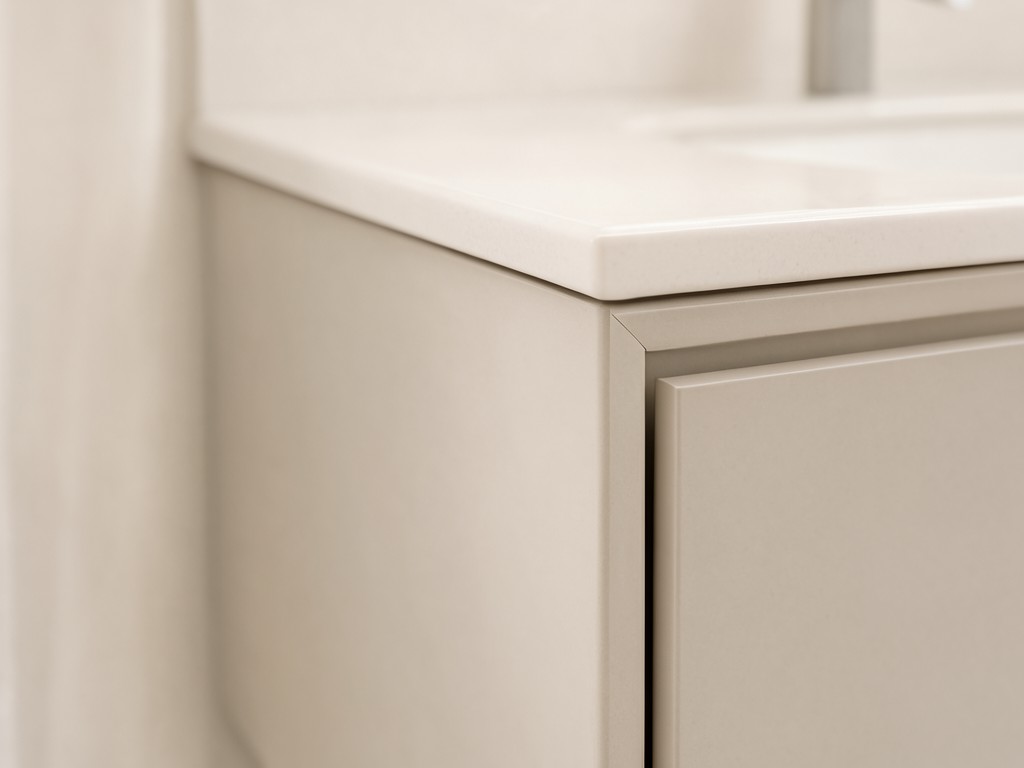
- Finish colour, sheen, edge treatment, handle position and hinge or runner requirements.
- Bathroom exposure, cleaning routine and expected installation conditions, including whether the cabinet may contact standing water.
Compare landed cost against likely replacement, service and warranty expenses. A lower-priced board or finish can raise total cost if swelling, edge lift or colour mismatch drives returns across a private-label batch.
What Can Be Customised and What Cannot
First-article tooling determines how freely a cabinet can change once the first sample is approved. Panel dimensions, drilling locations and cut-outs can be adjusted through revised drawings or CNC programs; each revision still needs a fit check against the basin, plumbing and selected hardware.
Colour, sheen, handle style, hinge selection and drawer layout are common OEM choices. A custom colour may require a minimum finish batch, while a non-standard door profile or curved panel can add tooling and sample time. Substrate behaviour cannot be removed by artwork or branding: specify the board and edge construction to suit the moisture conditions at the installation site.
Keep approved dimensions, hardware positions and colour references under revision control. If a supplier substitutes a board grade, edge material or finish formula without approval, the change can affect fit, appearance and warranty exposure even when the outer carton label stays the same.
OEM and ODM Programme Structure
Consistency is set at the forming stage: panel thickness, cut dimensions, edge-banding application and hole locations establish the fit of the finished cabinet. For a second-source programme, approve a first article against the same drawing revision and hardware list used for the incumbent product, then retain those references for repeat batches.
An OEM project can begin from a buyer-owned drawing, sample or specification. ODM development is better suited to buyers who need a supplier design adapted to their size range, finish palette or retail format; it requires agreement on design ownership, revision approval and any dedicated tooling before production.
OEM Supply
Best fit when the buyer controls the design. The supplier builds to approved dimensions, materials, finish references and packaging marks supplied for the order.
ODM Development
Useful when the buyer needs a developed cabinet configuration. Confirm drawing approval, finish samples, hardware selection and tooling responsibility before setting the production schedule.
For either route, record the approved sample, bill of materials and change history by product code. That record gives procurement and after-sales teams a basis for checking repeat orders and resolving batch-specific claims.
Inspection Items and Test Methods
Cabinets installed near sinks face splash exposure, cleaning chemicals and repeated door or drawer use. Inspection should tie each risk to a defined construction choice and check method; a general visual review alone will not identify a weak edge seal or a hole pattern that causes installation rework.
| Use condition | Common complaint | Specification and check |
|---|---|---|
| Frequent sink splash or damp cleaning | Swollen panel edges, lifted edging or finish damage | Specify substrate, edge material and sealed exposed cuts; inspect sample edges after controlled splash and wipe checks. |
| Daily household door and drawer cycles | Misaligned fronts, loose hardware or drawer binding | Fix hinge and runner models in the bill of materials; check opening, closing, alignment and fastener seating on assembled samples. |
| Multi-unit installation from one retail batch | Cabinets vary in size, drilling position or finish shade | Check critical dimensions, diagonal squareness, hole locations and finish against the approved reference within buyer-agreed tolerances. |
For batch approval, use a documented inspection plan with agreed sampling, measurement points and defect classifications. Confirm any test method and acceptance limit before order placement; performance depends on the selected board, finish system, assembly and exposure conditions.
Keeping Repeat Orders Supplied
Retail replenishment is easier to plan when the supplier confirms which cabinet sizes, board colours and hardware combinations remain active, and which finishes require a production batch. A second source can reduce supply concentration, but only if both suppliers work from aligned specifications and the buyer approves any material substitution before release.
Use the figures below as initial planning ranges, not commitments. Actual minimum order quantities and schedules depend on dimensions, finish batch size, component availability, sample approval and factory loading.
| Order stage | Planning lead-time range | MOQ and schedule factors |
|---|---|---|
| First sample and specification approval | Often 2–4 weeks after receipt of complete drawings and finish references | Non-standard profiles, colour matching and tooling can extend sample work. |
| Initial production order | Often 30–45 days after sample, materials and order details are approved | MOQ depends on cabinet configuration, finish run and hardware procurement. |
| Repeat order from an active specification | Often 25–40 days, subject to confirmed capacity and material stock | Stable forecast quantities and unchanged approved components support shorter planning cycles. |
For a specification review, share the target cabinet dimensions, substrate and finish preference, hardware schedule, forecast volume and current supplier issue. Request a review of your vanity cabinet specification before committing the second-source sample or production quantity.