durable vintage wall mounted bathroom vanity china factory: What Buyers Should Check Before Ordering
How It Performs in Use
Deflection under load governs whether a vintage-style vanity holds its shape over five years or bows within eighteen months. Most buyer complaints trace back to insufficient cross-bracing between the vanity carcass and the wall mounting brackets. When a user leans on the countertop or places a heavy basket on the open shelf, the load transfers directly to the mounting points. If the internal framework uses particleboard or thin MDF without steel reinforcements, the screws loosen, the unit sags, and the finish cracks at the stress points.
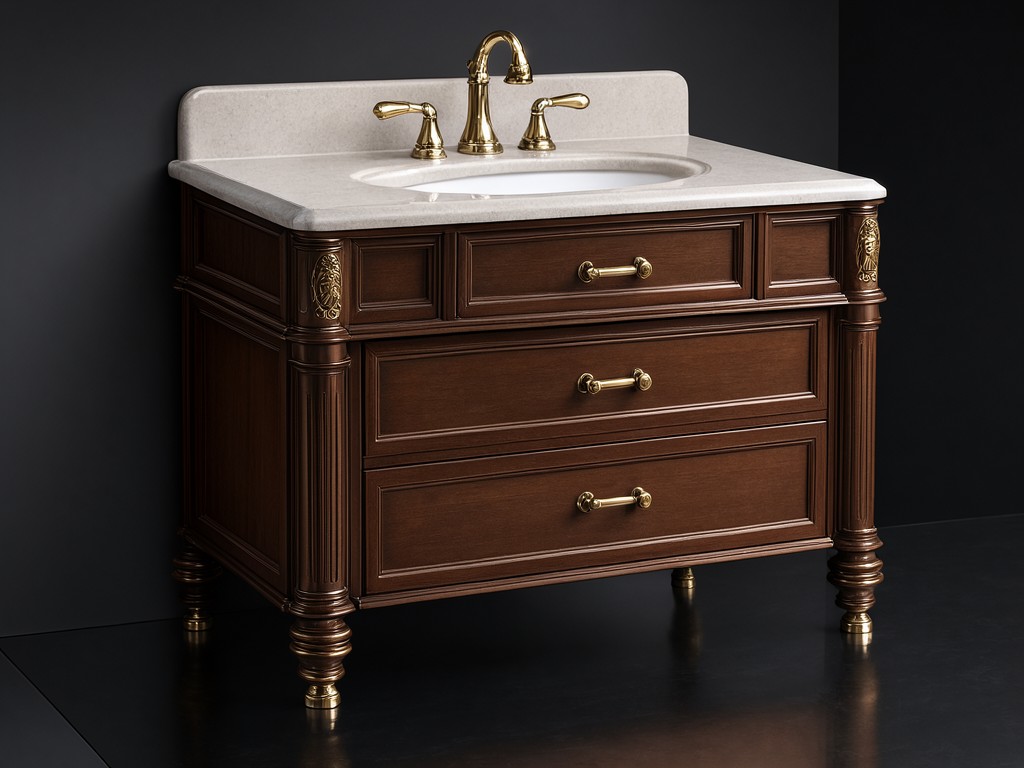
Weather resistance in a bathroom environment is not about rain; it is about humidity cycling and steam exposure. A vintage finish on a wall-mounted unit must withstand repeated condensation without blistering or peeling. This requires a multi-stage coating process: sanding, priming, and two coats of UV-stable topcoat. The critical failure mode is water ingress at the joint between the countertop and the cabinet body. If the sealant line is not continuous or the material swells with moisture, the wood core degrades, leading to structural failure long before the aesthetic finish fails.
How It Is Built and What That Changes
Consistency depends on the tolerance of the CNC milling and the rigidity of the assembly jig. A factory using manual sanding and hand-drilled holes will produce units where the mounting holes are off by 2-3 mm from unit to unit. This forces installers to ream holes or use spacers, increasing labor costs and delaying project completion. In contrast, a facility using CNC-routed carcasses with pre-drilled pilot holes ensures that every unit aligns perfectly with the wall studs and the countertop sink cutout.
Structural Trade-Off: Solid wood carcasses offer superior rigidity but are prone to warping if moisture content is not stabilized to 8-10% before finishing. Engineered wood (plywood or MDF) provides dimensional stability but requires edge banding and robust internal bracing to handle the leverage of a wall-mounted design. For bulk orders, engineered wood with steel-reinforced back panels is typically the cost-effective choice for maintaining flatness over time.
The "vintage" aesthetic relies on surface distressing techniques such as wire-brushing or chipping. This process is often manual, which introduces variability. A factory must define whether the distressing is random or patterned. Random distressing creates a unique look for each unit but makes quality control difficult, as there is no single reference standard. Patterned distressing allows for stricter QC but may look artificial if the patterns repeat too frequently across a large order.
Option Comparison by Usage Level
Balance and load analysis shows that residential and light commercial applications have different structural requirements. Residential units typically support 20-30 kg of static load, while light commercial units (boutique hotels, spas) may need to support 50+ kg due to larger mirrors and heavier fixtures. The difference is not just in the material thickness but in the hardware and internal bracing.
-
Residential Grade (Standard Duty)
- Carcass: 12-15mm MDF or Birch Plywood.
- Hardware: Standard zinc-plated brackets, 4-6 mounting points.
- Use Case: Primary bathrooms in single-family homes.
- Limitation: Not recommended for high-traffic areas or heavy stone countertops.
-
Commercial Grade (Heavy Duty)
- Carcass: 18-19mm Birch Plywood with steel corner brackets.
- Hardware: Stainless steel concealed mounts, 8+ mounting points.
- Use Case: Boutique hotels, high-end spas, frequent guest use.
- Advantage: Resists screw pull-out and counter-top deflection under repeated impact.
Quality Control and Batch Consistency
Lot-to-lot consistency is the primary risk when qualifying a second source. A buyer should request a "golden sample" approval process where a physical sample from the first production run is signed off before mass production begins. However, even with a golden sample, color drift can occur if the paint shop uses different batches of pigments or different humidity conditions during spraying. For vintage finishes, a delta-E value of less than 1.5 is typical for acceptable consistency; anything higher will be visible when units are installed side-by-side.
Dimensional consistency is equally critical. If the cabinet width varies by more than 1 mm across a batch, it creates visible gaps in the countertop installation. A capable factory will use laser scanning or manual caliper checks on at least 10% of the batch, with AQL (Acceptable Quality Level) standards applied to critical dimensions such as the distance between mounting holes and the overall width. The buyer should specify whether the tolerance is ±1 mm or ±0.5 mm, as tighter tolerances increase production cost due to higher rejection rates during assembly.
Capacity, Tooling and Scheduling
Tooling for wall-mounted vanities is less complex than for fully custom furniture, but it is not negligible. CNC programs need to be loaded and tested for each new model. If the buyer is ordering a new design, expect a 2-3 week tooling lead time for CNC setup and jig fabrication. For existing designs, tooling is already in place, but the factory must verify that the current jigs are calibrated. Worn jigs lead to cumulative error, where the first unit of the day is accurate, but the 100th unit is slightly off.
Scheduling is often the bottleneck. Many factories run their painting lines on a just-in-time basis, meaning they cannot hold large quantities of finished goods for long periods without incurring storage costs or risking damage. A buyer should align their order quantity with the factory’s standard production batch size to avoid partial runs. Partial runs increase the per-unit cost because the setup time for the paint booth is not amortized over a large number of units. Typically, a minimum order quantity (MOQ) of 50-100 units is standard to cover the setup costs for a specific color or finish.
Keeping Repeat Orders Supplied
Supply reliability hinges on the factory’s ability to maintain a stock of raw materials and sub-assemblies. If the factory does not keep a safety stock of the specific plywood or MDF grade required for the vanity, any supply chain disruption at the raw material level will delay the entire order. A reliable supplier will hold 2-4 weeks of raw material inventory for their core product lines. For vintage finishes, the paint and varnish suppliers must also be stable, as custom color mixes are not always available on short notice.
To mitigate risk, the buyer should establish a rolling forecast with the factory, providing a 3-6 month projection of demand. This allows the factory to plan raw material procurement and labor scheduling. It also creates a shared incentive for the factory to prioritize the buyer’s orders, as they can plan their capacity around a known volume. Without a forecast, the buyer is in the queue with all other customers, and delays are likely during peak seasons.
Care, Storage and Service Life
Storage conditions before installation are critical for maintaining the finish integrity. Vintage finishes are often hand-applied and may be more sensitive to UV exposure than modern sprayed finishes. If the units are stored in a warehouse with direct sunlight or high humidity, the finish may fade or peel before it even reaches the job site. The factory should pack the units in UV-stable packaging and store them in a climate-controlled environment. The buyer should verify the factory’s warehouse conditions during a site visit or via video audit.
Service life is determined by the weakest link in the assembly, which is usually the hardware. If the mounting brackets are made from low-grade zinc-plated steel, they will corrode in a humid bathroom environment within 2-3 years, leading to unit failure. The buyer should specify stainless steel or powder-coated hardware for all wall-mounted units. This small cost increase significantly extends the service life and reduces warranty claims related to structural failure.
Questions Buyers Ask Before Ordering
-
What is the dimensional tolerance for the mounting holes?
The factory should specify a tolerance of ±0.5 mm for critical dimensions. If the tolerance is wider, the buyer should require a ream-and-drill kit to be included with the hardware to ensure proper installation. -
How is the color consistency guaranteed across a large order?
The factory should provide a color sample from the first production run for approval. They should also commit to using the same batch of paint for the entire order to minimize color drift. A delta-E measurement can be requested if available. -
What is the lead time for a custom vintage finish?
Custom finishes typically add 1-2 weeks to the standard lead time. This is due to the need for color matching and multiple coats of paint and varnish. The buyer should confirm whether the lead time includes the tooling setup time for new designs.
Packaging and Freight Configuration
Wall-mounted vanities are fragile due to their thin profile and vintage finishes. Proper packaging is essential to prevent corner damage during transit. The standard packaging includes a wooden pallet, stretch wrap, and cardboard corner protectors. For air freight, the units should be packed in individual cartons to reduce the risk of crushing. For sea freight, palletization is more cost-effective, but the buyer should ensure that the pallets are treated with ISPM-15 heat treatment for international shipment.
| Packaging Component | Standard Specification | Notes for Buyer |
|---|---|---|
| Carton Box | 5-ply KRAFT, 120gsm | Ensure boxes are rated for the weight of the vanity + hardware. Add "This Side Up" labels. |
| Internal Cushioning | PE Foam, 10mm thickness | PE foam protects the vintage finish from scratches during handling. |
| Palletization | Wooden Pallet, 1200x1000mm | Pallets must be heat-treated (ISPM-15) for export. Stretch wrap with corner boards for sea freight. |
Request a Tooling Review
To move forward with a qualified second source, the next step is a detailed tooling review. This involves sharing your CAD files or detailed drawings with the factory’s engineering team to assess the feasibility of the design and the required tooling modifications. The factory will provide a cost breakdown for tooling, a sample lead time, and a mass production schedule. This review helps identify any potential design flaws or manufacturing constraints before any money is committed to production. Contact our engineering team to schedule a technical review and receive a formal quotation.